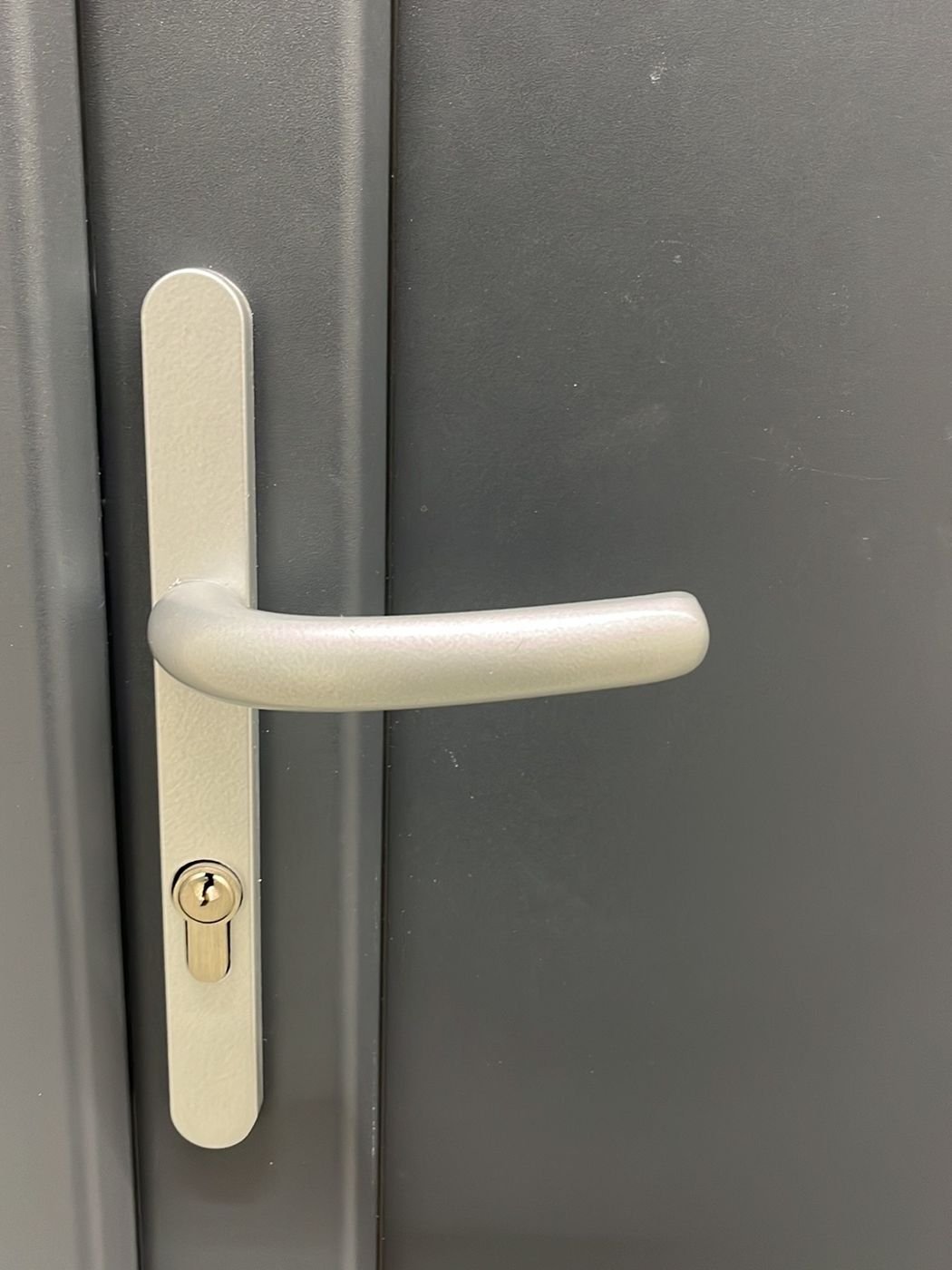
Three different symptoms, three different causes — and three different prices. A key that turns without doing anything, a key that no longer enters, and a lock that stops on the second turn each tell a locksmith exactly what is wrong.
These three calls arrive daily, and callers often describe them the same way — "my lock is broken". They are not the same problem at all. Here is how to read each symptom, what you can try safely, and what the fix usually costs.
The key rotates a full circle with no resistance and the bolts do not move. The cylinder's cam (the small tab that drives the lock) has broken or disconnected, or the connecting part inside a multipoint lock has failed. If the door is open: do not close it — you would lock yourself out with no way back. If it is closed and locked: this is an emergency opening, often non-destructive by working on the mechanism rather than the cylinder (from €150, cylinder replacement included if needed). Nothing to try yourself except not forcing.

Three possibilities. A foreign object in the keyway — a fragment of a previous key, a matchstick, glue (yes, vandalism with glue happens on Paris doors): look with a torch; if you see something, a locksmith extracts it in minutes, as for a broken key. A wrong or worn key: try another copy, ideally the original. Dirt and dry pins: a stiff key that goes in halfway is our seized lock case — a dry lubricant, never oil. If the key goes in but turns freely, see above.
The first turn works, the second forces or stops. On a multipoint lock, the second turn throws the bolts further; if it blocks, the bolts are hitting the strike plates because the door has dropped or swollen — the lock is fine. Test with the door open: if both turns are smooth, it is alignment, fixed by adjusting hinges and strikes (from €90). If it blocks door open too, the mechanism is worn or a bolt is bent, and the lock case needs servicing or replacing (from €390 for a new 3-point). Forcing the second turn is how multipoint locks get destroyed; stop at the first resistance.
A photo of the lock from inside and outside, a short video of the symptom, and your door type. We tell you which of the three cases it is and the price before anyone is dispatched — in English, 24/7, on +33 6 51 77 08 49.
One call in English — a fixed price — a technician at your door in ~30 minutes.